The Email That Made Me Pause Longer Than Usual
A few days ago, I received an email from a reader who has been following my writing for a long time. I recognized her name right away. She has written before, always gently, never asking for attention, only letting me know that she reads, that she notices. This time, her message stayed with me longer…
A few days ago, I received an email from a reader who has been following my writing for a long time.
I recognized her name right away. She has written before, always gently, never asking for attention, only letting me know that she reads, that she notices. This time, her message stayed with me longer than most.
She wrote to tell me how much she enjoys reading about my flower garden, how the details help her imagine the space clearly, even though she has never seen it in person.
I felt deeply grateful reading her words. Writing can feel like sending thoughts into the wind, so moments like that matter more than I ever admit.
At the end of her message, she asked something simple.
“Besides roses, peonies, or lilies,” she wrote, “is there any flower in your garden that feels different? Something large, something that surprises people when they see it?”
I sat quietly after reading that. My first instinct was to answer quickly, but instead, I closed the laptop and walked outside.
Remembering the Tree I Often Forget to Mention
As soon as I stepped into the garden, the answer became obvious. I do not know why I forget to write about it so often – the magnolia tree.
Maybe because it does not bloom for long, or maybe because it stands slightly apart, never asking to be the center of attention.
It has been there for years, growing steadily, quietly, doing its work without asking to be noticed. And yet, when it blooms, it changes everything around it.
Where the Magnolia Lives

The magnolia stands near the eastern edge of the garden, where the ground rises just enough to catch the first light of morning. That area feels different from the rest of the garden.
The soil is deeper and looser, darker in color, and the air moves gently there, never rushed by strong wind.
The tree is tall now, close to thirty feet, with a straight, confident trunk and wide branches that spread gradually outward.
Also, the bark is smooth and pale, marked only by subtle lines of age. Even when it is not blooming, the tree feels present, like it is holding the space around it intentionally.
You notice the magnolia before you reach it, not because it draws your eye loudly, but because the area around it feels quieter.
How It Came to Be There

My grandmother planted the magnolia more than ten years ago. At the time, it was a young tree, barely taller than she was, thin and unimpressive to anyone who did not understand patience.
She chose it after careful thought, reading about varieties that could handle our winters and asking advice from people who had waited years to see their own bloom.
She planted it knowing she might not enjoy its full beauty right away.
“This one is for the future,” she told me at the time. “Some trees are not meant to reward us quickly.”
She chose the location herself, marking the spot with a small stone before digging, making sure it would have enough space to grow without competition. Watching it now, I realize how much foresight that required.
The Moment It Blooms
The magnolia blooms in early spring, often before the garden feels fully awake. It does not wait for leaves to appear first. Instead, the flowers open on bare branches, which makes them feel even more striking.
Each bloom is large, easily eight to ten inches across, thick and firm, shaped like open cups.
The petals are smooth and heavy, creamy white with a soft hint of pale pink near the base. They open slowly, one by one, never all at once, and if the weather is kind, they hold their shape for several days.
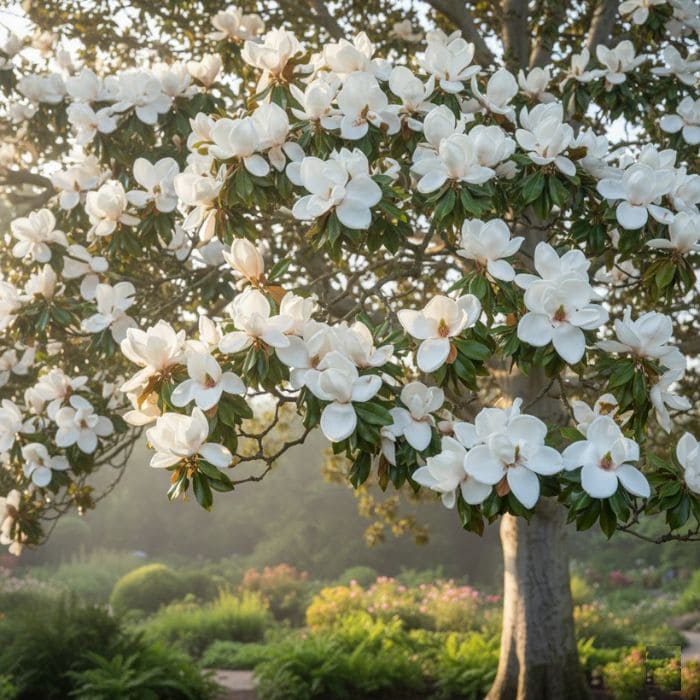
The scent is subtle but unforgettable. It is not sweet like roses, and not sharp like citrus. It is clean, soft, slightly creamy, with a calm presence that feels almost cooling. You notice it most in the morning, when the air is still and the light is low.
Standing beneath the magnolia then feels like stepping into a quieter world. The scent does not travel far. It stays close, rewarding those who come near.
Why I Call It the Japan Corner
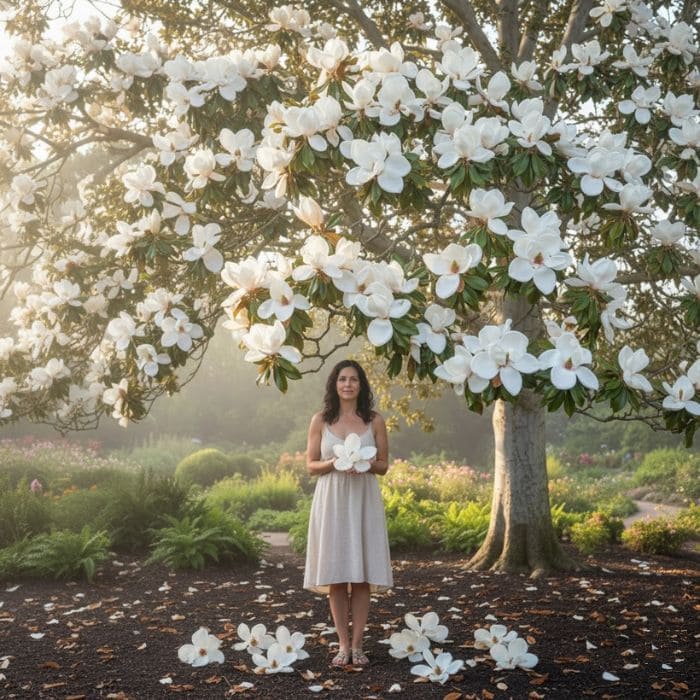
Over time, I began calling that part of the garden the Japan corner. Not because it is designed in any formal way, and not because I have ever been to Japan. I have not. But the feeling it gives me reminds me of the images I have carried for years.
I think of photographs and films I have seen. A single flowering tree standing in a calm space, open ground, balance and stillness.
A sense that nothing needs to be added or taken away. The magnolia stands there like it belongs to a place where beauty is allowed to be simple and temporary.
That corner of the garden is not crowded. My grandmother placed a few stones there years ago, nothing decorative, just enough to define the space.
The ground is mostly open. When the magnolia blooms, the area feels almost ceremonial, like the garden is briefly practicing restraint.
I often walk there alone, especially in the early morning, and stand beneath the branches without touching anything.
Answering Her Question
When I replied to the email, I told her about the magnolia. I described where it stands, how tall it has grown, how large the flowers are, and how my grandmother planted it knowing she would have to wait.
I told her how the blooms appear before the leaves, how they last only a short time, and how their scent stays close, never asking for attention.
I told her that the magnolia is special to me not because it blooms often, but because it teaches patience. Because it reminds me that some beauty appears, stays briefly, and leaves without regret.
And maybe that is why I forget to write about it sometimes. Because it does not try to stay. It simply arrives when it is ready, and that feels enough.