When the Heart of the Garden Had to Learn a New Shape
For years, the center of my garden belonged to hibiscus. They were planted there long before I understood what that space really needed, tall plants with wide, open faces that caught attention immediately. Every summer they bloomed generously, reds and pinks standing out from a distance, their petals thin and almost glowing in direct sunlight. …
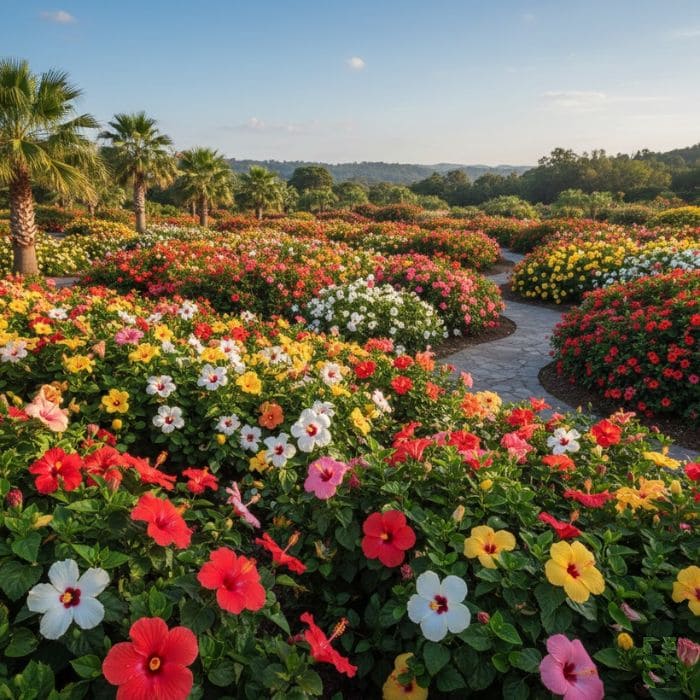
For years, the center of my garden belonged to hibiscus. They were planted there long before I understood what that space really needed, tall plants with wide, open faces that caught attention immediately.
Every summer they bloomed generously, reds and pinks standing out from a distance, their petals thin and almost glowing in direct sunlight.
When visitors walked into the garden, their eyes went there first. It felt like the right thing at the time, something bold at the center, something that announced itself.
The Storm That Changed Everything

Last summer, Willow Bend was hit by a storm that arrived without warning and refused to pass quickly. The wind came in hard from the west, strong enough to bend trees that usually never move. Rain followed in heavy sheets, soaking the soil faster than it could drain.
I stood with my grandmother near the window, watching the garden struggle against it, neither of us speaking, both of us knowing this one felt different.
When the storm finally moved on, we walked the garden together. Most plants survived with little more than bruised leaves and bent stems.
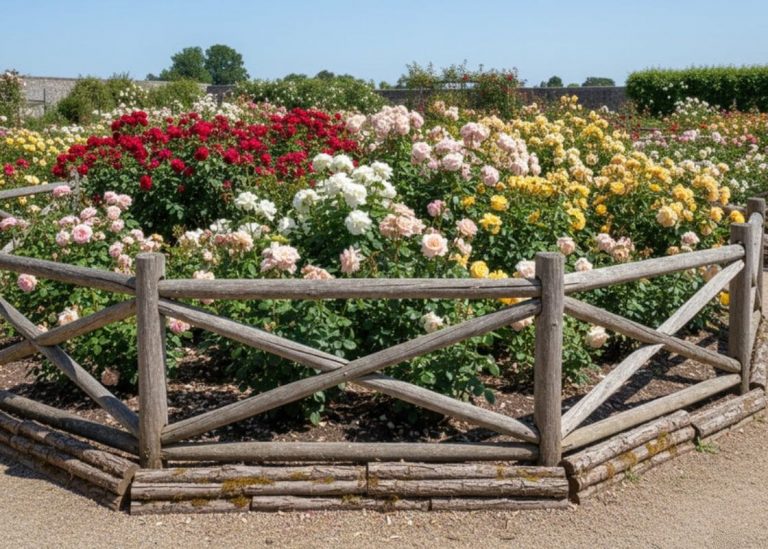
Roses held their ground. Coneflowers leaned and then straightened themselves again. Even younger plantings recovered after a few days. The hibiscus did not.
Their roots had lifted and twisted. Some plants leaned sharply, others had fallen completely, their root balls exposed and heavy with wet soil.
They had grown tall and beautiful, but their anchoring was shallow, and the center of the garden had become a weak point instead of a stable one.
Deciding Not to Replace, but to Rethink
For days after, my grandmother and I talked about that space. We walked it slowly, morning and evening, feeling how the ground held water, noticing how wind moved across it.
We could have replaced the hibiscus with something similar, another tall flowering plant, another focal point. But the storm had already answered that question for us.
“This place doesn’t need to rise,” my grandmother said. “It needs to stay.”
That was when we chose creeping thyme. This plant grows low, spreads wide, and binds soil together instead of lifting away from it. Its roots knit into the ground slowly but firmly. It does not compete for height or light.
We committed fully. Nearly one kilometer of ground, stretching through the center of the garden and along the gravel path that leads from the entrance inward, was planted that season.
We worked section by section, hands close to the soil, spacing plants carefully, knowing the real result would not show itself for a long time.
One Full Year of Quiet Work
The first months were unremarkable with small plants, gaps of bare soil. Creeping thyme does not rush. It spreads when it is ready, not when you ask it to.
By late fall, there was more green than brown. By early spring, the ground looked intentional again. And by this summer, the transformation was complete.

The center of the garden is now a living ground cover that stretches farther than the eye expects.
Creeping thyme has woven itself into a continuous carpet, soft but dense, covering nearly one kilometer of land. Its leaves are small and tight, mostly deep green with hints of silver that catch the light.
In early summer, tiny flowers appear, soft purples and pale pinks scattered low across the ground, never overwhelming, always balanced.
Along the gravel path, the thyme spills gently between stones, softening the edges without taking over.
When you walk there, it brushes your ankles lightly. When you step off the path, the ground feels firm, dry, and steady beneath your feet.
A Different Kind of Life Moves Through It
Butterflies hover low now, closer to the ground than before. They move slowly, landing and lifting again, drawn to the small flowers.
Bees visit too, quietly, never clustering too thickly. The scent of thyme rises gently when the sun warms it, clean and herbal, especially noticeable in the afternoon when the air is still.
The atmosphere of the garden changed with it. The center no longer pulls your eyes upward. It invites you to look down, to slow your steps, to stay.
A Weekend Lived Right There
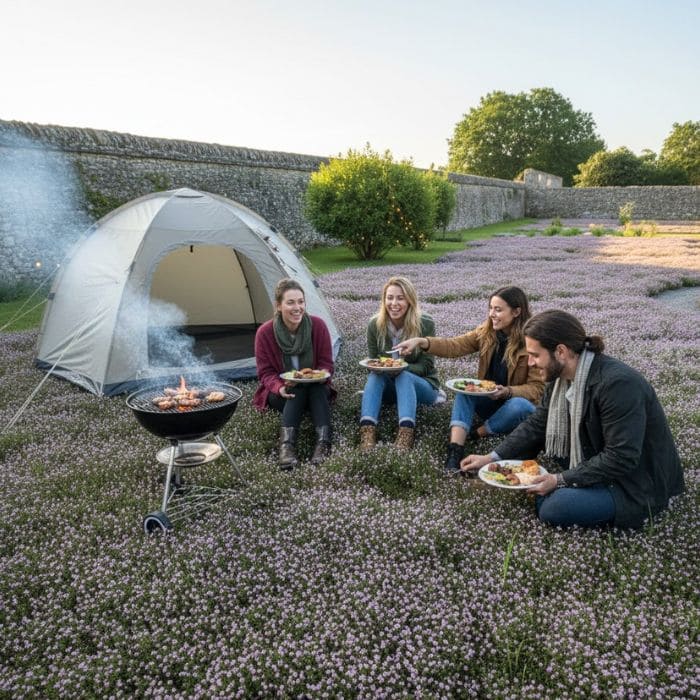
Last weekend, I shared that space in a way I never had before. My closest friends came to stay, and instead of gathering near the house, we decided to camp right in the center of the garden.
We set up a tent beside the gravel path, the creeping thyme spreading out beneath us like a natural mat.
As evening came, we grilled barbecue nearby, the scent of food mixing with the herbal smell of thyme.
We sat low, plates in our laps, talking without rushing, laughing when someone dropped a fork into the grass and had to search for it. Someone brought a camera, and we took photos without posing, catching moments instead of planning them.
Later, we lay directly on the ground, backs pressed into the thyme, heads close together, watching the sky darken. The ground held us easily without dampness, or sharp stones.
Sleeping With the Garden Around Us
That night, we zipped ourselves into the tent and slept there. The ground stayed dry. The air stayed calm.
I woke once in the middle of the night and could smell thyme through the fabric of the tent, faint but steady, like the garden was still awake even while we rested.
In the morning, everything felt settled. No mess, no damage, just signs of life returning to its rhythm.